Why your brain notices everything going wrong while ignoring decades of hard-earned wisdom, resilience, and impressive chaos management.

Somewhere along the way, we got really good at a LOT of things.
Managing careers, households, kids, pets, aging parents, relationships, appointments, and remembering to pay the power bill. Mostly.
We're creative problem solvers! We're flexible. We can juggle approximately 87 moving parts while simultaneously making something that technically qualifies as dinner.
We've spent decades developing skills, experience, and resilience. We've been kicking a$$!
And then perimenopause shows up and starts screwing with everything.
Suddenly we're forgetting single-syllable words, yelling at the dog, waking up at 2:06 AM, and wondering why things that used to feel manageable are now so. Freaking. Hard.
Did someone change the difficulty setting without telling us?!
Your Brain Has a Complaint Department. It's Very Efficient.
Here's something interesting about our brains: they're often much better at noticing problems than appreciating successes.
Psychologists call this negativity bias, our tendency to give negative information more attention or weight than positive information.
From an evolutionary perspective, noticing potential threats is pretty useful. Forgetting where you put your coffee? Annoying. Forgetting where you saw that saber-toothed tiger? Potentially catastrophic.
Unfortunately, our brains don't always distinguish between actual danger and everyday frustrations.
So you might successfully manage a complicated workday, solve three family problems, get everyone fed, and remember to schedule the dentist.
But what sticks in your mind?
That you forgot the word spatula during a conversation.
Congratulations! Your brain has decided that is today's headline.
And during perimenopause, when hormonal changes, disrupted sleep, and other symptoms may affect how we feel and function, there can be even more frustrating moments demanding our attention.
The menopause transition also involves measurable changes in the brain as it adapts to changing hormone levels. Scientists are still figuring out exactly what those changes mean for everyday functioning.
But here's what I want you to remember:
Having difficulty with something doesn't mean you've suddenly become incompetent at everything.
You've Got Skills. You Just Forgot to Put Them on Your Résumé.
There's another useful concept from psychology called self-efficacy.
It's essentially your belief in your ability to handle challenges and accomplish things.
One way we develop that confidence is through experience. We try things, make mistakes, solve problems, and discover that we can manage more than we originally thought.
And by midlife? We've had plenty of opportunities to practice.
We've navigated difficult relationships, disappointing outcomes, unexpected emergencies, terrible haircuts, and at least one decision involving skinny jeans that probably seemed reasonable at the time.
We've learned what works for us and what doesn't.
Personally, I've gotten much better at protecting my sleep, exercise, and health. I don't waste nearly as much energy worrying about things that used to occupy valuable mental space.
I also know that social media makes me feel terrible, even when I only intended to watch cute kitten videos. So I try to stay away.
And I'm perfectly happy being a beginner at something!
I've been making ceramics for quite a while, and my collection of slightly misshapen bowls continues to grow. They're not especially impressive, but I enjoy making them.
That's progress, too.
One of the benefits of experience is learning that we don't have to be excellent at everything to enjoy our lives.
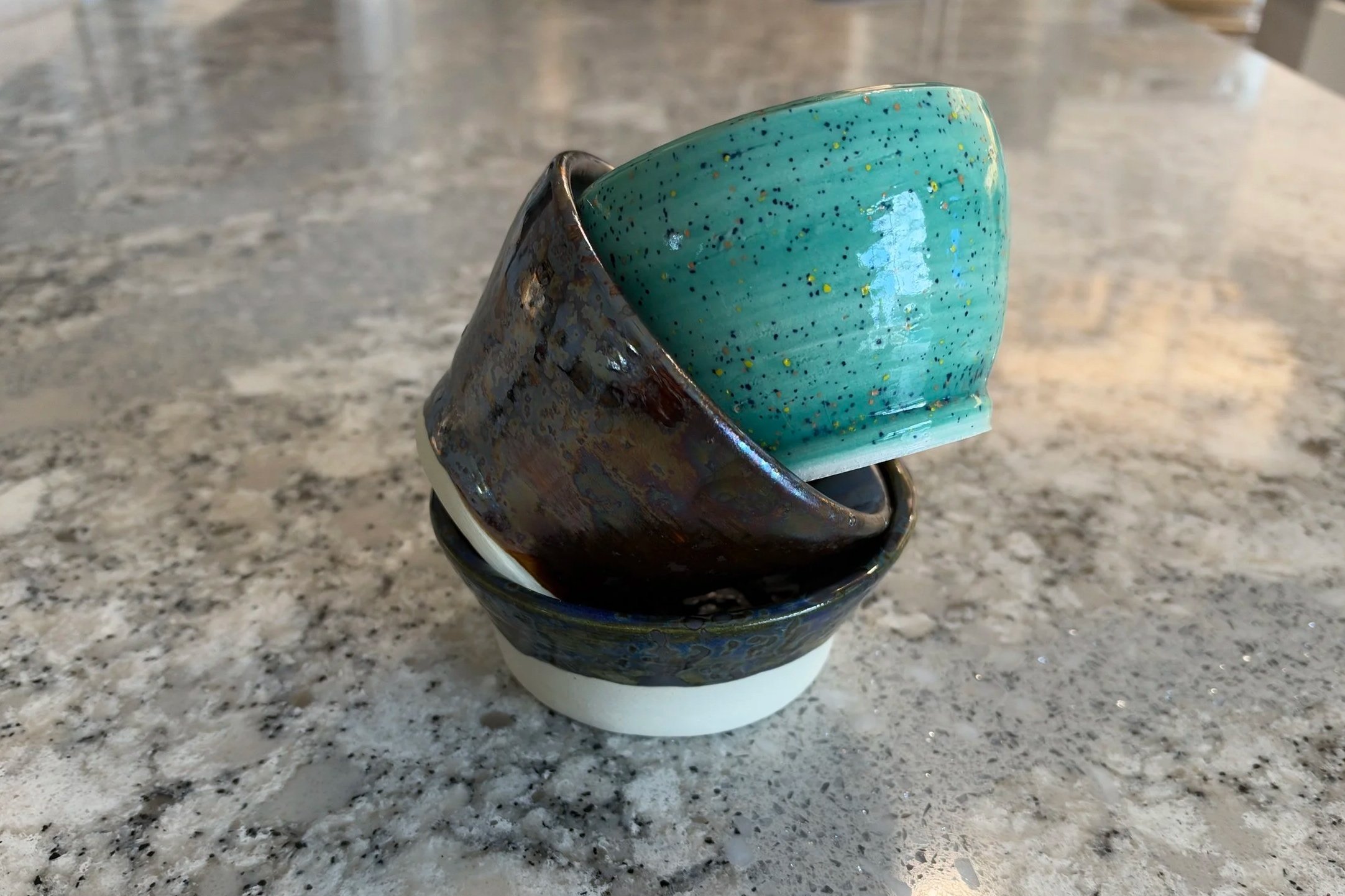
Yup, pretty mediocre, but so fun to make!
Just Because You CAN Tolerate It Doesn't Mean You SHOULD
Here's another thing I've noticed about women in midlife.
We can tolerate a lot.
Pain. Stress. Anxiety. Disappointment. Exhaustion. Other people's nonsense.
Sometimes we're so good at managing difficult situations that everyone just assumes we'll keep managing them.
And sometimes we assume that, too.
But being capable of carrying something doesn't mean it belongs on your shoulders indefinitely.
Maybe the strength you've developed isn't your ability to keep pushing through.
Maybe it's recognizing when to stop.
To set a boundary. Ask for help. Delegate something. Get treatment for symptoms you've been tolerating for years.
Or simply announce that you are no longer the household's designated finder of missing objects.
(Seriously. Has anyone else noticed that people will look directly at something and then ask where it is?)
Resilience is a wonderful strength. But it shouldn't become a lifetime subscription to unnecessary suffering.
A Little Strength-Spotting Exercise
Here's something to try.
Instead of making another list of things you need to improve, identify:
Three strengths you've developed over the years. Maybe you're resourceful, persistent, compassionate, creative, or excellent in a crisis.
One thing you're better at now than you were 20 years ago. It doesn't have to be impressive to anyone else.
One thing you're ready to stop tolerating. Because knowing your limits is a skill, too.
This isn't about pretending everything is wonderful or replacing medical treatment with positive thinking.
It's about noticing the whole picture instead of letting your brain's complaint department write your entire autobiography.
You can be anxious and capable. Exhausted and resourceful. Frustrated and wise.
And yes, you can have perimenopausal brain fog while still being the person everyone calls when something needs to get done.
Now Hiring: Perimenopause Superheroes!
Speaking of underappreciated skills...
I've created a ridiculous little Peri-Blanks Superhero Application to celebrate some of the more questionable abilities we develop during midlife.
Can you remove three layers of clothing in four seconds? Have you developed innovative strategies for surviving a sleepless night? Do you possess an impressive tolerance for nonsense?
We may have a position for you.
Apply to the Women's Division of Superheroes Program!
Fill out the application and you'll receive your own personalized, delightfully ridiculous superhero story by email.
Because sometimes recognizing your strengths means appreciating your wisdom and resilience.
And sometimes it means laughing about the fact that you can manage an entire household but can't remember why you opened the refrigerator.
Both count.
