The Midlife Health Pyramid: Start With the Basics That Matter Most
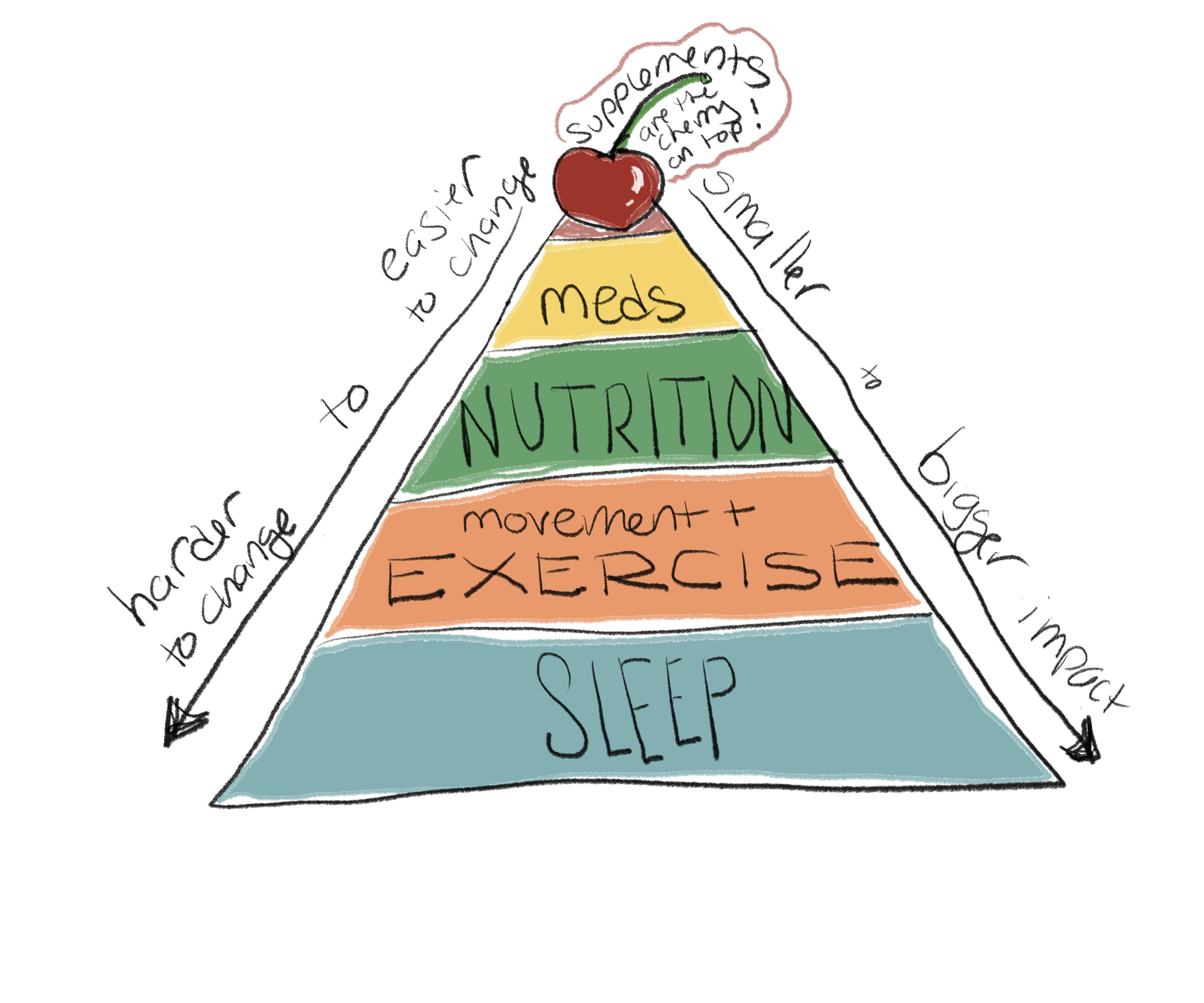
A psychiatrist's simple midlife health pyramid for prioritizing sleep, exercise, nutrition, medications and supplements
There’s a little pyramid I talk about with patients all the time.
It’s basically my hierarchy of Things Most Likely to Help You Feel Better, and unfortunately, the bottom of it is filled with things you probably already know you’re supposed to be doing.
Rude.
My pyramid looks like this:
SLEEP
MOVEMENT + EXERCISE
NUTRITION
MEDICATIONS
And perched at the very top are SUPPLEMENTS, like a tiny wellness cherry. 🍒
The basic idea is simple:
The things near the bottom of the pyramid tend to affect a LOT of other things. They're also often the hardest things to change.
The things near the top may be easier to add, but they're usually working on top of the foundation underneath them.
And therein lies our problem.
We Really Like the Top of the Pyramid
I understand why.
Taking magnesium takes approximately three seconds.
Getting enough sleep consistently requires bedtime boundaries, schedules, routines, possibly dealing with night sweats, putting down your phone and accepting that whatever fascinating thing you suddenly need to Google at 10:47 PM can probably wait until morning.
Exercise isn't particularly mysterious either.
Most of us know moving our bodies is good for us.
But knowing that and rearranging an already-full life so that exercise actually happens consistently are two very different things.
Nutrition?
Same problem.
We generally know that eating a reasonably balanced diet with enough protein, fiber, fruits and vegetables is probably better for us than surviving entirely on coffee and whatever we found in the cabinet while standing over the office kitchen sink.
The problem usually isn't knowing the basics.
It's doing them consistently.
So we naturally start looking for easier ways to feel better.
Sometimes those easier things help!
But they can't always compensate for what's happening underneath them.
This Is a Framework, Not a Treatment Algorithm
Before anyone throws away their medication and goes to bed at 8 PM, that's not what I'm saying.
Medication can be incredibly important.
Hormone therapy can be incredibly important.
There are medical and psychiatric conditions that need actual treatment, and I'm certainly not suggesting you should earn the right to medication by first achieving perfect sleep, exercise and nutrition.
That's not how this works.
Instead, I use the pyramid as a way to zoom out.
If we're trying to improve mood, energy, cognition, stress tolerance or overall health, are we paying attention to the foundation too?
Or are we spending all our energy tinkering with the cherry?

Don't Make the Goal Smaller. Make the Step Smaller.
This is the part I think we often miss.
We decide we're going to "get healthy."
So starting Monday we're going to exercise five days a week, completely change how we eat, go to bed at 9:30, meditate every morning and become someone who meal preps on Sundays.
That's a lot of Monday.
Instead, I think the trick is to keep the bigger goal and make the next step ridiculously small.
Want to improve your sleep?
Turn on Focus mode an hour before bed and try getting into bed 10 minutes earlier this week.
Want to exercise regularly?
Start with seven minutes a few days per week next week.
Want to improve your nutrition?
Add some protein to the breakfast you're already eating.
Then do it all again.
That's Pretty Much How I Did It
I definitely did not wake up one morning as someone who exercised six days a week and protected (almost) 8 hours of in-bed time.
I started with sleep.
Once my kids were reliably sleeping through the night, I decided it was time to start protecting my own sleep too. Just by 15 minutes at a time, over months.
Then I added exercise.
My beginning workout plan was an app with seven-minute workouts three times a week.
7 minutes.
That was enough.
Eventually the workouts got longer. I added days. Over many months, those small changes grew into exercising most days of the week for 60+ minutes and consistently giving myself enough time in bed to get the sleep I needed.
It wasn't fast.
It wasn't perfect.
And it wasn't always easy.
But eventually something happened that made those small-ish efforts feel even more worthwhile:
Other people noticed.
My family could see the difference in my energy and in how I interacted with them.
Taking care of myself wasn't taking something away from them.
They were benefiting from it too.
Talking with them about what I was trying to change also helped. My routines weren't just mysterious new rules appearing in our household. They understood what I was working toward and why it mattered to me.
That made it easier to protect the changes long enough for them to become part of my life.
“Most of the Time” Is Wildly Underrated
I don't do all of these things perfectly now.
Nobody does.
I miss workouts. I stay up too late. I eat things because they're delicious and not because I've carefully evaluated their fiber content.
That's life.
The goal was never perfection.
The goal was to make choices that support my health most of the time.
Because one seven-minute workout isn't going to transform your health.
Going to bed 10 minutes earlier tonight probably won't either.
But small choices repeated over and over have a funny way of becoming routines.
And routines have a funny way of becoming a life.
Start at the Bottom
So if you're currently wondering what you should change to feel better, take a look at your own pyramid.
You don't have to fix the whole thing.
Just ask:
What's one small thing I could do near the bottom of my pyramid that would move me in the right direction?
Maybe it's protecting 10 more minutes of sleep.
Maybe it's walking around the block.
Maybe it's adding something nutritious instead of trying to completely overhaul your diet.
Pick something small enough that it almost feels silly.
Then practice doing it consistently.
Because becoming healthier usually isn't about suddenly becoming a different person.
It's about making small, repeated choices that help you become the person you're trying to be.
